The Sickness is the System: When Capitalism Fails to Save Us from Pandemics or Itself by Richard D. Wolff
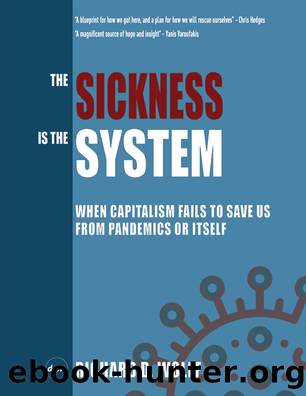
Author:Richard D. Wolff
Language: eng
Format: epub
ISBN: 9781735601311
Mass Unemployment Is a Failure of Capitalism
May 8, 2020
Independent Media Institute
The difficulties caused to workers by record unemployment during the pandemic are a product of capitalism. Most of the time, employers decide to hire or fire workers depending on which choice maximizes employersâ profits. Profit, not the full employment of workers nor of means of production, is âthe bottom lineâ of capitalism and thus of capitalists. That is how the system works. Capitalists are rewarded when their profits are high and punished when they are not. Itâs nothing personal; itâs just business.
Unemployment is a choice mostly made by employers. In many cases of unemployment, employers had the option not to fire employees. They could have kept all employed but reduced their hours or days or else rotated off-work times among employees. Employers can choose to retain idled employees on payrolls and suffer losses they hope will be temporary.
However, unemployment is received almost everywhere and by almost all as a negative, unwanted experience. Workers want jobs. Employers want employees producing profitable output. Governments want the tax revenues that flow from employees and employers actively collaborating.
So why has the capitalist system periodically produced economic downturns wherever it has settled across the last three centuries? They have happened, on average, every four to seven years. The United States has had three crashes so far this century: âdot-comâ in 2000; âsub-prime mortgageâ in 2008; and now âcoronavirusâ in 2020. Thus the United States conforms to capitalismâs ânorm.â Capitalists do not want unemployment, but they regularly generate it. It is a basic contradiction of their system.
There are good reasons why capitalism produces and reproduces unemployment over time. It draws benefits (as well as suffers losses) from doing so. Reproducing a âreserve army of the unemployedâ enables periodic upsurges in capital investment to draw more employees without driving up wages. Rising wagesâand thus falling profitsâwould accompany investment surges if all workers were already fully employed before such surges. Unemployment also disciplines the working class. The unemployed, often desperate to get jobs, give employers the opportunity to replace existing employees with unemployed candidates willing to work for less.
Unemployment thus operates as a downward pressure on wages and salaries and thereby a boost for profits. In short, capitalism both wants and does not want unemployment; it expresses this tension by periodically adding to and drawing down a reserve army of the unemployed that it continually maintains.
That reserve army exposes a stark reality that no ideological gloss ever fully erases. While unemployment serves capitalism, it does not well serve society. That key difference is most glaringly in evidence when unemployment is very high, as it is today. Consider that todayâs many unemployed millions continue much of their consumption while ceasing much of their production. While they continue to take their means of consumption from socially produced wealth, they no longer produce nor thereby add to social wealth as they did when employed.
Unemployment thus entails wealth redistribution. Part of the wealth produced by those who are still employed must be redistributed away from them and to the unemployed.
Download
This site does not store any files on its server. We only index and link to content provided by other sites. Please contact the content providers to delete copyright contents if any and email us, we'll remove relevant links or contents immediately.
| Anthropology | Archaeology |
| Philosophy | Politics & Government |
| Social Sciences | Sociology |
| Women's Studies |
The Secret History by Donna Tartt(19297)
The Social Justice Warrior Handbook by Lisa De Pasquale(12224)
Thirteen Reasons Why by Jay Asher(8998)
This Is How You Lose Her by Junot Diaz(6955)
Weapons of Math Destruction by Cathy O'Neil(6365)
Zero to One by Peter Thiel(5867)
Beartown by Fredrik Backman(5839)
The Myth of the Strong Leader by Archie Brown(5552)
The Fire Next Time by James Baldwin(5503)
How Democracies Die by Steven Levitsky & Daniel Ziblatt(5271)
Promise Me, Dad by Joe Biden(5189)
Stone's Rules by Roger Stone(5130)
A Higher Loyalty: Truth, Lies, and Leadership by James Comey(5017)
100 Deadly Skills by Clint Emerson(4972)
Rise and Kill First by Ronen Bergman(4838)
Secrecy World by Jake Bernstein(4798)
The David Icke Guide to the Global Conspiracy (and how to end it) by David Icke(4771)
The Farm by Tom Rob Smith(4550)
The Doomsday Machine by Daniel Ellsberg(4550)
